Ridding Your Kid of Head Lice
How to check for head lice and find the right head lice treatment

How to check for head lice and find the right head lice treatment
Head lice are tiny parasitic bugs that no parent wants to face. That’s because they tend to latch on to pre-school and school-age children and wreak havoc on a household when not caught early.
Yes, they are creepy, crawly parasites and can cause a lot of itching. But they are largely harmless. Though the live on the scalp, they don’t cause serious illness and are not known to carry any diseases. Still, they are a nuisance, and for one major reason: Getting rid of head lice can be difficult.
Head lice crawl quickly and avoid light. In order to get rid of them, you must often do a second treatment several days later to kill any live bugs that remain. Sometimes over-the-counter treatments don’t work because they are not used correctly, or the head lice have become resistant, at which point you may have to seek a prescribed medication.
You may also feel a little anxious or embarrassed that it was your child who got lice. Doctors say there is nothing to feel shame about. “Having head lice is fairly common, particularly among young children,” says Trieva Scanlan, MD, a pediatrician at Scripps Coastal Medical Center Carlsbad. “Getting it has nothing to do with hair length or hygiene. Anyone who has direct head-to-head contact can become infested, no matter how often they bathe.”
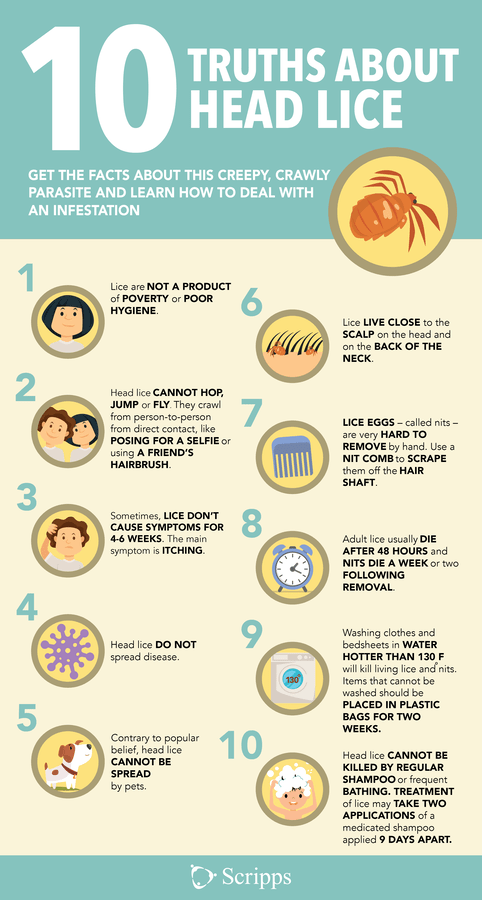
Who gets lice?
Head lice infest anywhere from six to 12 million children ages three to 11 every year, according to the Centers for Disease Prevention and Control. Though young children are most affected, anyone can get head lice.
Head-to-head contact is the main way head lice spreads. Close contact often happens during play at school, at home, sports activities and slumber parties. In the age of group selfies, head lice have been known to spread among teens while huddling to take pictures or look at screens. Less common is infestation through sharing of clothing, hats, towels, hair ribbons, combs, brushes and pillows.
What does head lice look like?
Head lice are about the size of a sesame seed. They live in human hair and on the scalp and feed on small amounts of blood from the scalp. They can reproduce very quickly, which is why early detection is vital.
Their life-cycle comes in three stages. The adult lice lay their eggs — called nits — on strands of hair, close to the scalp. It takes eight to nine days for nits, which look like white to yellow-brown specks, to hatch into nymphs. It takes nine to 12 days for nymphs to become adult lice. A female louse can lay up to 10 eggs per day.
Signs of head lice
Contrary to popular belief, head lice cannot jump, hop or fly, but they are crawling insects. That is where that tickling feeling of something moving in the hair comes from. The itching sensation is not caused from lice bites, but from an allergic reaction that develops to lice saliva.
“It can take several weeks to feel the itching of an initial infestation, so you may not be aware of a lice problem until it has infected the entire household,” Dr. Scanlan says. “The best way to protect the rest of the family is with prompt treatment.”
How to check for head lice
Pediatricians recommend regular checks for head lice. Spotting them early can prevent an infestation. While head lice can reproduce quickly, they can only live a day or two off the scalp.
“If you notice your child scratching his or her head or are notified of an outbreak at school do a thorough check,” Dr. Scanlan advises. Diagnosis is best made by finding a live nymph or adult louse on the scalp or hair of a person.
“Under good light, use a fine-tooth comb to help you search the scalp section by section,” he says. “The easiest place to find them is at the hairline at the back of the neck or behind the ears.” Be careful not confuse nits, which are firmly attached to hair, for dandruff, which are not.
The comb-out method helps remove nits and head lice, but it usually doesn’t work alone to get rid of lice. The American Academy of Pediatrics says the most effective way to get rid of lice is with head lice medicine. “Make sure to use the medication correctly and pay special attention to instructions on the label,” Dr. Scanlan advises. “Store it safely. Never let the child apply the medicine.”
Head lice treatment
Check with your child’s pediatrician before starting any head lice treatment. In general, head lice can be treated at home.
There are two prominent over-the-counter medications: permethrin and pyrethrin. “These are the least toxic formulas,” says Dr. Scanlan.
- Permethrin (Nix) is approved for use in children two months and older.
- Pyrethrin (RID) is approved for children two years and older.
These treatments are washed through the hair. A special nit comb should be used to remove the nits from the hair. Metal nit combs tend to be more effective at removing these sticky eggs.
For most over-the-counter medications, retreatment is recommended nine days after the initial treatment. Most medications don’t kill nits and a second treatment is often needed to kill lice that hatch after the first treatment. For parents who want help removing the nits, there are specialty hair salons that will apply the treatment and remove the nits.
Home remedies for head lice
Home remedies, such as mayonnaise, olive oil, margarine, butter or similar substances, are an alternative to using medications and are meant to suffocate the lice and make them easier to remove. There is no clear scientific evidence to determine if suffocation is an effective treatment, according to the CDC.
The CDC does not recommend using any fumigator or fogger in the house to treat the lice or treating your pets for lice.
If you want to be cautious, you may clean items that have been in recent contact with the affected person.
- Machine wash clothing and linens in water of at least 130 degrees Fahrenheit.
- Items that cannot be washed can be placed in plastic bags for two weeks.
- Soak combs and brushes in hot water.
- Vacuum areas where the infested person has been sitting or sleeping.
Remember to see a doctor if over-the-counter treatments don’t work or if you need to confirm a diagnosis. Recurrent infestations also warrant a trip to the pediatrician.
“We are seeing some resistance to some of the over-the-counter treatments. If they don’t work, it’s time to see a doctor, who may recommend a stronger, prescription treatment,” says Dr. Scanlan.