Sudden Cardiac Arrest in Young Athletes: What to Know
Learn the causes, warning signs and how CPR and AEDs can save lives
Learn the causes, warning signs and how CPR and AEDs can save lives
Key Takeaways
- Sudden cardiac arrest in young athletes is rare but life-threatening.
- Underlying heart conditions can increase an athlete’s risk.
- Heart screenings may help identify underlying heart conditions.
- Immediate CPR and AED use can save lives.
During a “Monday Night Football” game in 2023, millions of people watched as Buffalo Bills safety Damar Hamlin collapsed after making a routine tackle. He had suffered sudden cardiac arrest, a life-threatening emergency that occurs when the heart suddenly stops pumping effectively.
Sudden cardiac arrest is relatively rare but remains a concern for teens and young adults. Roughly 2,000 healthy Americans under age 25 die from sudden cardiac arrest every year. Research shows that sudden cardiac arrest affects approximately 1 in 50,000 college athletes and 1 in 80,000 high school athletes annually.
“Sudden cardiac arrest is a life-threatening heart rhythm problem that’s caused when the bottom chambers of the heart beat too fast,” says John Rogers, MD, a cardiac electrophysiologist at Scripps Clinic La Jolla. “And if that heart rhythm problem doesn’t get reset back to normal, then a person will die within minutes.”
Is sudden cardiac arrest the same as a heart attack?
Although often confused, sudden cardiac arrest and a heart attack are different medical emergencies. A heart attack occurs when blood flow to the heart muscle is blocked.
Sudden cardiac arrest occurs when the heart unexpectedly stops pumping blood effectively. A heart attack can, however, lead to cardiac arrest.
What causes sudden cardiac arrest in young people?
One of the leading causes of sudden cardiac arrest in young athletes is hypertrophic cardiomyopathy, an often inherited condition in which the heart muscle becomes abnormally thick and may obstruct blood flow.
As Dr. Rogers explains, playing youth sports does not necessarily increase the risk of sudden cardiac arrest. However, strenuous exercise can trigger a cardiac event in people with underlying heart conditions, such as hypertrophic cardiomyopathy, long QT syndrome and Brugada syndrome.
Sudden cardiac arrest can also result from commotio cordis, as in Hamlin’s case. This occurs when a blow to the chest at a specific moment in the heartbeat cycle triggers a dangerous heart rhythm.
What are the warning signs of sudden cardiac arrest?
Sudden cardiac arrest can occur without warning. However, certain symptoms may indicate an underlying heart condition. Talk to a doctor if a young athlete experiences:
- Lightheadedness or dizziness
- Fainting spells
- Unexplained shortness of breath
- Heart racing
- Chest pain, particularly during exercise
Signs of sudden cardiac arrest itself include sudden collapse, unresponsiveness and an absence of normal breathing.
Can heart screenings help prevent sudden cardiac arrest?
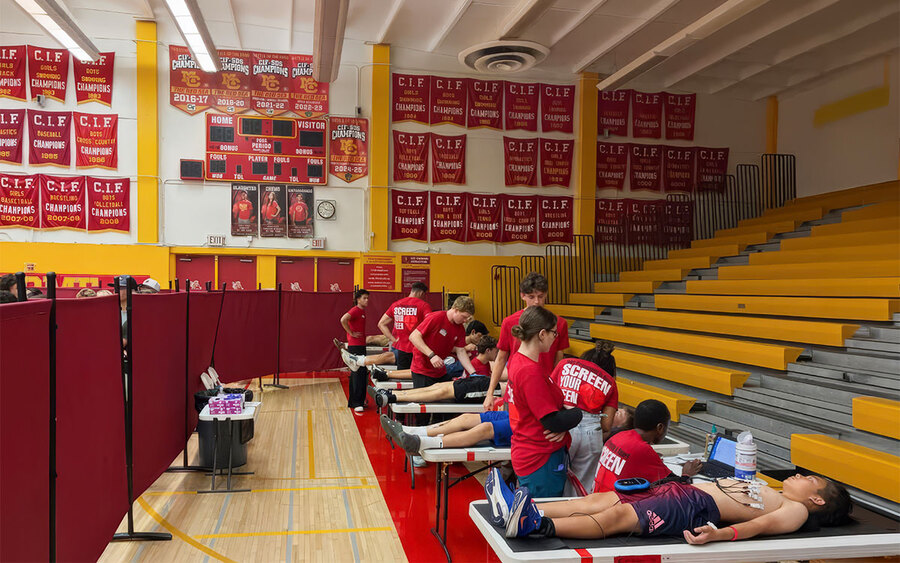
Heart screenings can help identify underlying conditions that increase a young athlete’s risk of sudden cardiac arrest. Screening typically includes a physical exam and a review of personal and family medical history.
Additional testing may include an electrocardiogram (EKG), to check the heart’s electrical activity, or an echocardiogram (ultrasound of the heart), to evaluate its structure and function.
Dr. Rogers has spent years working to raise awareness of sudden cardiac arrest among young people, including through school-based heart screening programs.
“After screening 47,000-plus kids for the last 16 years, I think every person deserves to have an EKG at least once, and that in middle school or high school is the best time to do it,” he says. “When we screen kids, we save lives.”
Because some conditions linked to sudden cardiac arrest are inherited, it's important to share any family history of heart disease during that screening process.
Heart screenings can identify certain risks but cannot detect every condition that may cause sudden cardiac arrest.
Heart screenings for young athletes in San Diego
Scripps supports the Eric Paredes Save a Life Foundation, which offers free heart screenings for young people ages 12 to 25 throughout San Diego County. These screenings can help identify previously undetected heart conditions that may increase the risk of sudden cardiac arrest.
The foundation also promotes CPR and AED training to help families and communities prepare for cardiac emergencies.
How is sudden cardiac arrest treated?
Sudden cardiac arrest needs immediate medical attention. Without CPR and defibrillation, a person's chances of survival can decrease 7% to 10% with each passing minute.
Cardiopulmonary resuscitation (CPR) and an automated external defibrillator (AED) can help save lives. CPR keeps blood flowing to vital organs, while an AED can deliver an electrical shock when needed, to restore a normal heart rhythm.
The importance quick action was demonstrated in Damar Hamlin's case. Immediate medical intervention helped save the Buffalo Bill player's life, allowing him to eventually return to professional football.
AEDs are increasingly available in public places, including gyms, airports, stadiums, shopping malls and parks. Designed for use by anyone, even those without medical training, these devices provide voice instructions and analyze the heart's rhythm to determine whether an electrical shock is needed.
“If a defibrillator is not available, or if it didn’t work to bring the heart rhythm back to normal, then performing CPR on the person is important to keep the heart pumping the blood until more help arrives,” Dr. Rogers says.
Dr. Rogers also helped teach high school students CPR and AED use through a pilot program. Just three months later, two participants used their training to help someone experiencing cardiac arrest.
What to do if someone experiences sudden cardiac arrest
If someone suddenly collapses, is unresponsive and is not breathing normally or is only gasping, quick action could save their life.
- Call 911. Ask someone nearby to call 911 and get an AED. If you're alone, call 911 and put your phone on speaker.
- Begin CPR. For a teen or adult, push hard and fast in the center of the chest at a rate of 100 to 120 compressions per minute.
- Use an AED. As soon as one is available, turn it on and follow the voice instructions.
- Continue CPR. Follow the AED’s instructions and continue CPR until emergency responders take over or the person begins breathing normally or moving.
This content appeared in San Diego Health, a publication in partnership between Scripps and San Diego Magazine that celebrates the healthy spirit of San Diego.