ECMO Excellence: What Scripps’ Platinum Designation Means for Patient Care
Scripps La Jolla has what’s now the only platinum-level ECMO program in Southern California
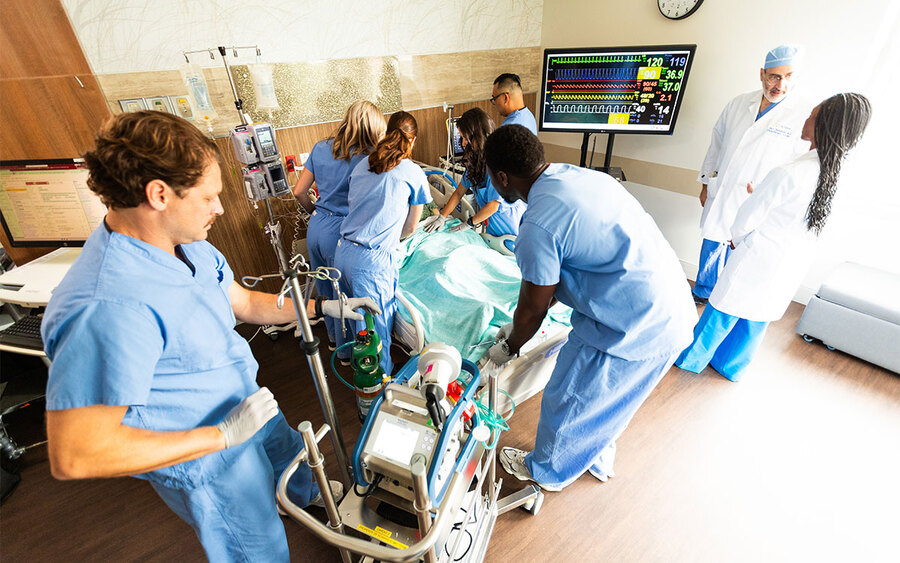
Scripps La Jolla has what’s now the only platinum-level ECMO program in Southern California
When a critically ill patient’s heart and lungs are failing, their Scripps care team may use an extracorporeal membrane oxygenation (ECMO) machine to save their life. Scripps Memorial Hospital La Jolla’s ECMO program was recently recognized with a platinum designation from the Extracorporeal Life Support Organization (ELSO), an international consortium that promotes best practices and clinical guidelines for ECMO care.
Scripps La Jolla’s program is now the only platinum-level ECMO treatment program in Southern California and one of just four on the West Coast.
The distinction reflects years of experience in ECMO care in San Diego, clinical excellence, innovation and collaboration across the hospital’s critical care team.
What is ECMO?
An ECMO device is a form of extracorporeal life support (ECLS) that circulates blood out of the body, infuses it with oxygen and removes carbon dioxide before pumping it back in.
Scripps cardiac specialists typically use ECMO’s lifesaving heart and lung support when conventional interventions, such as medications and mechanical ventilators, are no longer effective. The specialized life-support machine serves as a short-term treatment for individuals experiencing severe heart attacks or sudden organ failure, helping to further tissue damage and life-threatening complications.
Caring for patients on ECMO requires a highly skilled, collaborative team. Scripps relies on a multidisciplinary network of experts across intensive care, cardiology, pulmonology, neurology, infectious disease and related fields to manage every stage of treatment.
What does ELSO’s platinum designation mean?
Platinum is ELSO’s highest tier of its Award of Excellence for ECMO/ECLS programs. Programs progress through three levels of recognition: silver, gold and platinum. The designation is not something a hospital can simply apply for. Programs must first meet rigorous eligibility requirements, including years of ECMO experience, sufficient patient volume and comprehensive reporting of every ECMO patient to the ELSO Registry.
Platinum recognition is reserved for programs that demonstrate performance and innovation exceeding the standards of their peers. Unlike a designation based solely on patient outcomes, ELSO evaluates the systems supporting those outcomes, including clinical quality measures, specialized equipment, defined protocols, staff training, education and continuous improvement.
Only about 48 programs worldwide hold platinum status among more than 700 ELSO centers, making it a particularly distinguished achievement. The designation lasts three years, after which programs must requalify.
“The platinum designation is a testament to our teamwork — one of the core guiding principles of our program is a multidisciplinary approach where physicians from different specialties, nurses and nurse specialists, respiratory and other therapists, pharmacists and social workers come together to ensure that we’re providing the absolute best care that we can,” says Rajeev Mohan, MD, an advanced heart failure and transplant cardiologist and co-director of the ECMO program at Scripps Clinic.
Because platinum designation reflects a level of innovation relative to peer programs, the bar is a moving target that rises as the field improves, notes Juliann Eigner, RN, senior director, patient care, Scripps Memorial Hospital La Jolla.
“For our patients and families, all of that translates into something simple: when they come to Scripps, they’re receiving the highest level of ECMO care from a team that is all in every time,” Eigner says. “But it’s also bigger than just what we do at Scripps La Jolla. Our goal is to extend that level of care across the entire San Diego community, so that patients throughout the county have access to a highly experienced ECMO team when they need it most.”
Bringing advanced ECMO care to patients across San Diego
One of the most significant developments in Scripps’ ECMO capabilities was expanding access to the lifesaving treatment via the Scripps Critical Care Transport Team and its specialized ambulance. The specialized ambulance serves as a mobile intensive care unit and is equipped with an ECMO device. Previously, it was considered too risky to transport certain critically ill patients before they were stabilized.
“Scripps Critical Care Transport team lets us take the expertise of our ECMO program beyond the walls of Scripps La Jolla. It gives us the ability to reach patients across San Diego County — from Chula Vista to Encinitas — and bring them back to a center equipped to provide this level of care,” says Eigner.
Multidisciplinary care for the most critical patients
Though the platinum designation is new, the highly coordinated care the ECMO team provides is not. During the past several years, the program has grown to meet the changing needs of the diverse San Diego County population.
The approach to patient care has evolved to ensure that the team employs the most up-to-date practices, and research has expanded as well. Scripps has launched an internal database to track outcomes and quality more closely as the program grows.
“This has helped our physicians, nurses and staff gain experience across the board. The higher our volume, the better we get,” says Dr. Mohan.
Eigner adds that ECMO’s capabilities have also evolved. Once seen as a last resort for the sickest of the sick, ECMO is now used more strategically.
“As we’ve learned more about ECMO and how to use it, we’ve come to realize there are many situations where it can serve as a bridge to recovery or to another therapy,” she says.
Some practices that once seemed nearly impossible are now part of the program’s approach, including:
- Transporting patients on ECMO. Specialized teams can transfer critically ill patients while maintaining life-sustaining support.
- Mobilizing patients during treatment. Some patients can be awakened and supported in walking while still receiving ECMO, depending on their condition.
- Rapid initiation of ECMO. In certain emergency situations, patients experiencing cardiac arrest can be transported from the scene to the hospital and placed on ECMO in the emergency department in less than an hour.
The program has also expanded across all five Scripps campuses, giving patients throughout the health system access to advanced ECMO care at Scripps La Jolla and specialized transport services, regardless of which hospital they initially visit.
“Our program has continued to grow because we’ve been willing to challenge what we thought was possible and keep moving the standard of care forward,” Eigner says.
This content appeared in San Diego Health, a publication in partnership between Scripps and San Diego Magazine that celebrates the healthy spirit of San Diego.