As seen in San Diego Health Magazine
How Scripps Helps Premature Babies Thrive
Learn how specialized NICU care, expert neonatal teams and family support at Scripps helped a premature baby overcome serious complications and thrive.
How expert newborn care and family support helped one premature baby overcome a hard start and grow into a happy, healthy toddler
Caroline Petersen is a planner. She likes to be ready for anything life may bring. At just 20 weeks pregnant, Caroline toured Scripps Memorial Hospital La Jolla, where she planned to give birth. She wanted to see the Women's Center, the labor, delivery and recovery rooms, and the doctors and nurses who would care for her and her newborn daughter.
She felt calmer after learning about the unit and the team that would watch over her.
“I just wanted to be really prepared,” she says.
Fortunately, she was, because babies don’t always follow their moms’ plans.
Caroline’s early prep helped her act fast when pregnancy problems led to an emergency C-section and the premature birth of her daughter. Through specialized care from neonatal specialists from Scripps Memorial Hospital La Jolla and Rady Children’s Hospital San Diego, Bella got urgent treatment and long-term support during a 114-day hospital stay.
When every minute matters
Earlier in her pregnancy, Caroline was diagnosed with placenta previa, a condition in which the placenta blocks the cervix, and was being monitored closely for potential complications. It was later determined that she had marginal sinus previa, a specific type of placenta previa where a blood vessel is attached to the placenta. This increases risk of bleeding or other serious complications, depending on whether the vessel is attached to the fetus or the mother. Caroline was referred to perinatology for further ultrasound testing to be sure.
But the baby had other plans. Before that follow-up appointment could happen, Caroline woke up in the middle of the night, bleeding, with a headache and unable to feel her normally active baby kicking. She knew something was wrong — and she knew exactly where she needed to go.
“At the visit they said if I had any bleeding, go straight to labor and delivery. Because we had done the tour, I knew where that was,” she recalls. “I knew minutes were critical, so knowing where to go really helped.”
Kim Bui, MD, was the OB-GYN on call when Caroline and her husband, Keith, arrived at 3:40 a.m. on Feb. 2, 2024. She caught up on Caroline’s history and was ready to deliver the baby.
“In this case, the baby was OK on the monitor, but the mom was actively bleeding, so we thought it was better to proceed with the delivery,” Dr. Bui says. “Sometimes, we can wait to see if the situation resolves itself. But this was a case where we needed to take action.”
Naturally, the Petersens had concerns.
“My husband said, ‘She’s too little — can’t we wait and see?’ But the doctor said that at any moment one of us could become unstable,” Caroline recalls.
Caroline went in for an emergency C-section, and at 4:19 a.m., less than an hour after they arrived at the hospital, baby Isabella (Bella) was born, weighing just 2 pounds, 3 ounces.
“She came out punching and ready to fight,” Caroline remembers.
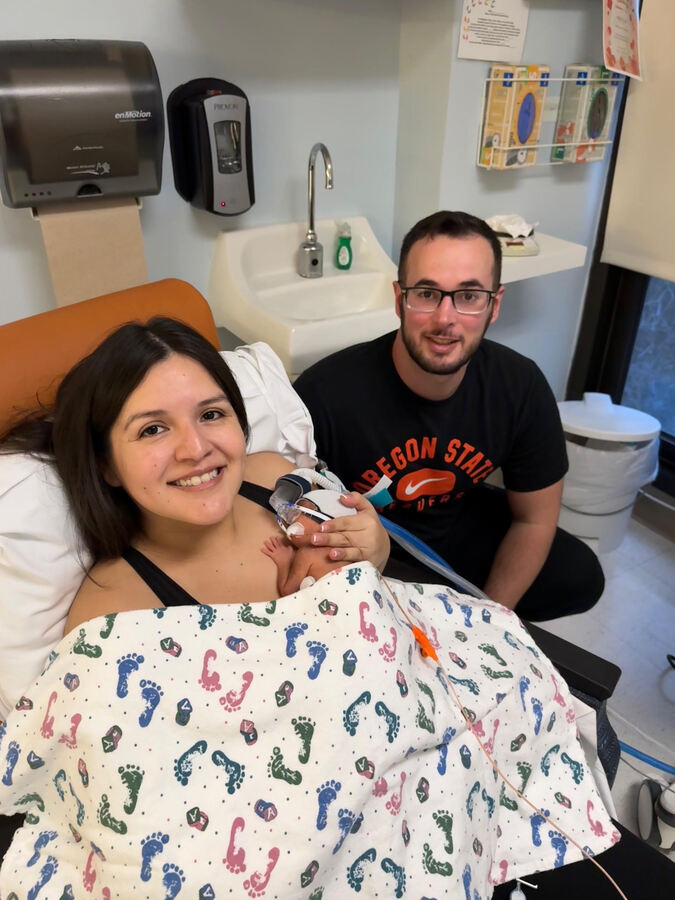
Baby Bella was born more than three months early. She was immediately taken to the NICU for specialized care.
Next stop: Specialized NICU care
Tiny Bella was immediately taken to the neonatal intensive care unit (NICU). Scripps NICUs provide specialized care through a unique partnership with Rady Children’s Hospital San Diego, which has a nationally ranked neonatology program. Together, Scripps and Rady Children’s collaborate to deliver exceptional care for premature and critically ill newborns, plus NICU family support. The Level III NICU at Scripps Memorial Hospital La Jolla is expertly staffed by Rady Children’s neonatologists and NICU nurses trained to provide highly specialized care to the most vulnerable newborns.
Casey Cohenmeyer, MD, a Rady Children’s neonatologist and medical director of the Rady Children’s NICU at Scripps Memorial Hospital Encinitas, explains the value of the Scripps/Rady Children’s partnership.
“It’s a very close relationship between the two facilities, and to the patient, it appears seamless,” she explains. “There are not a lot of places where you can deliver your baby and then stay in the same hospital while they’re in the NICU. This way, moms can receive care at Scripps and have the full resources offered by a multidisciplinary system, while their babies can also get specialty care under one roof.”
More than three months early, Bella undoubtedly needed specialty care.
“Bella was so premature,” Dr. Cohenmeyer says. “She had a complicated course, but she was eventually able to improve. And her parents were unflappable throughout the whole thing. They were calm and gracious, and just an amazing family.”
“I became so close to the nurses, respiratory therapists and doctors. ... They are so knowledgeable and kind, and they really want to support you and your baby. Of course, my next baby is getting delivered at Scripps. I wouldn’t feel comfortable having my next baby anywhere else.”
Home away from home
Bella’s “complicated course” lasted 114 days. That’s nearly four months that she and her devoted parents spent in the Scripps NICU. It was a time filled with ups and downs, stressing about major setbacks and celebrating tiny milestones. From day one, Caroline spent as much time as she could by her daughter’s side.
“On that first day, after I woke up and she was stabilized, I was finally able to go see her,” Caroline recalls. Seeing her baby for the first time — tiny and attached to a breathing machine — brought conflicting emotions.
“I held her, and it was very emotional, but I didn’t feel that sheer joy people say they experience,” she says. “We didn’t get that ‘golden hour’ or the initial skin-to-skin contact. And I think because of the circumstances, I didn’t allow myself to get fully attached to her because we didn’t know if she was ever going to come home with us.”
Dr. Bui explains that feelings like Caroline’s are common among mothers who deliver preterm. For that reason, every mother with a baby in the NICU is offered the services of a social worker to help them navigate feelings of anxiety and depression that come from having a highly vulnerable newborn. Thankfully, Caroline also had her family come to San Diego from the East Coast to celebrate Bella’s arrival and give Caroline the support she needed in her first days as a new mother.
“My mom had been in town the whole time because she was going to appointments with me, but instead I had my baby,” she says. “Then several family members flew in. I had a large corner room, and everyone was there. They gave me a lot of TLC that I really needed to help me get through those first days.”
Caroline had been warned that NICU babies sometimes have a “honeymoon period,” where things seem fine, but can deteriorate later. Caroline was all set to be discharged on day two, but once again, Bella had other plans. Her esophagus hemorrhaged, a life-threatening situation that put everyone on edge.
“We almost lost her that day,” Caroline says.
Bella recovered but took her time improving. Weeks later, she needed an emergency transport to Rady Children’s for surgery on a patent ductus arteriosus, an open blood vessel on the heart that’s common in premature babies. It was there that Caroline got to kiss her baby for the first time.
“In the NICU, contact with your baby is very limited,” she explains. “Before her heart procedure, the staff said, ‘Parents don’t leave this room without kissing their baby on the forehead.’ That was the first time we were able to be that close to her.”
Bella’s heart procedure went smoothly, and she was transferred back to the neonatal specialists at Scripps and to her NICU caregivers, with whom Caroline had already become very close.
“The team at Scripps was like our family,” she says. “I was glad to get back there, and they were excited to have us back.”
For the next few months, it wasn’t always smooth sailing. Bella developed pneumonia and was the sickest she had ever been. But at the same time, there were small moments worth celebrating.
“She was growing, and we were celebrating every gram she gained,” Caroline says. “But then she’d go backwards, and it was like Groundhog Day all over again.”
Bella eventually turned a corner, and her healthy times lasted longer. Caroline and Keith were able to be more hands-on with their baby and provide the care parents normally give their newborn.
“I was there every day from 8 am to 5 pm, and my day was based on the staff’s care time routine,” she explains. “Every three hours, it was my turn to hold her or change her diaper. That was a gift for us. We were able to contribute by checking her temperature, and that was also a gift. Every three hours, I’d get to be a mom.”
Home at last
Eventually, those three-hour increments added up to 114 days, and it was finally time for Bella to go home. Caroline bought her a tiny cap and gown for the occasion, and on May 24, 2024, baby Bella went home, surrounded by a big “Congratulations” sign, balloons and a whole lot of fanfare from her NICU family.
Thus began a whole new life outside of the hospital. While it hasn’t been easy, today, Bella is a happy, healthy toddler, unaware of the journey it took her to get here.
“Bella graduated from the NICU follow-up program, and they told us it’s incredible how well she’s doing for a 26-weeker, especially after all she went through,” Caroline says. “She’s a chatterbox, she’s sassy and she’s smart as a whip!”
Caroline says she’s also doing well, thanks to therapy, which she highly recommends to all new mothers who have experienced high-risk pregnancy and delivery. She and Keith are almost ready to embark on a second pregnancy, one she hopes will be much less eventful than the first.
One thing she’s sure she wants to be the same: delivering at Scripps.
“I became so close to the nurses, respiratory therapists and doctors. They were the only people I would talk to all day every day, and there are some I still keep in touch with,” she says. “They are so knowledgeable and kind, and they really want to support you and your baby. Of course, my next baby is getting delivered at Scripps. I wouldn’t feel comfortable having my next baby anywhere else.”

Bella is thriving thanks to the care she received in the NICU at Scripps Memorial Hospital La Jolla.
This content appeared in San Diego Health, a publication in partnership between Scripps and San Diego Magazine that celebrates the healthy spirit of San Diego.
Get a free guide
Fill out the form to learn more about Planning the Birth of Your Baby in our free guide. Call 858-330-6149 to find an OB-GYN who is right for you.
Related medical services
Perinatology

Perinatology
Experts in high-risk pregnancy, Scripps perinatologists manage common and rare complications, such as diabetes, preeclampsia and placenta accreta.
Pregnancy and Childbirth Care

Pregnancy and Childbirth Care
At Scripps, you will find a complete range of childbirth services in San Diego, including prenatal care, perinatology, postpartum care and classes.
Related locations
Scripps Memorial Hospital La Jolla
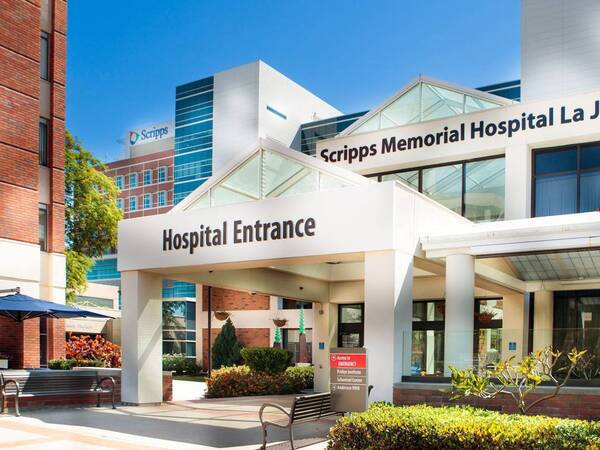
Scripps Memorial Hospital La Jolla
9888 Genesee Ave.
La Jolla, CA 92037
Related providers

Kim Bui, MD