
As seen in San Diego Health Magazine
A wounded police officer's incredible recovery
A San Diego officer defies the odds thanks to lifesaving trauma care and a dedicated team at Scripps.
On the night of Dec. 7, 2023, San Diego police Sgt. Anthony Elliott’s life changed forever. He was responding to a report of a stolen vehicle spotted outside a grocery store in 4S Ranch. When the suspect exited the store, Sgt. Elliott gave chase.
“As he was running away, he pulled a gun out of his waistband, and at the angle I was chasing him, I didn’t see it,” he recalls. “He shot me in the head — I was about five feet away from him.” He remembers hearing the exchange of gunfire and then officers coming to his aid.
“I was still able to communicate, and I had them look for an exit wound,” he says. “I knew if the bullet went one end and came out the other, I probably wasn’t going to make it.”
Sgt. Elliott — Tony to his friends, family and fellow officers — was rushed to Scripps Memorial Hospital La Jolla. Remarkably, he remained conscious and lucid the entire time. His wife, high school sweetheart Laura, and two children were the only things on his mind.
“All I could think about was my family and playing with my kids again,” he says.
He was lucky to have survived. But the real battle was about to begin.
Scripps trauma team springs into action
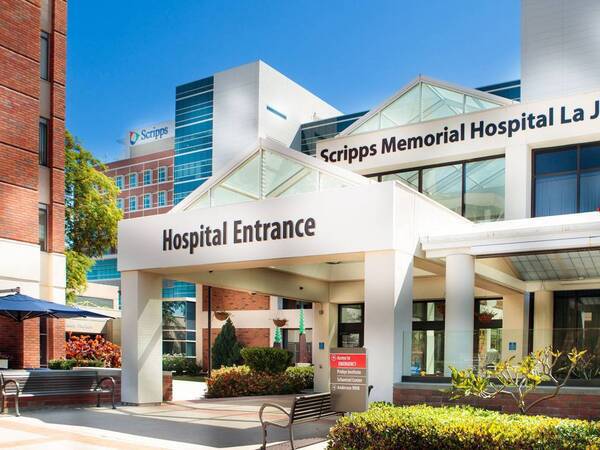
The Barbey Family Emergency and Trauma Center at Scripps Memorial Hospital La Jolla is one of two Level I trauma centers in the Scripps system. Expert trauma surgeons, specialists and multidisciplinary staff are on hand 24/7 to provide the highest level of care for any critical injury that comes through the door.
When the trauma center team learned Tony was en route, the protocol was to immediately call a major trauma activation. Staff assembled to quickly assess Tony and determine the next steps in his care.
In the trauma bay, the team checked for other wounds, took X-rays and blood samples, and prepared Tony for a CT scan.
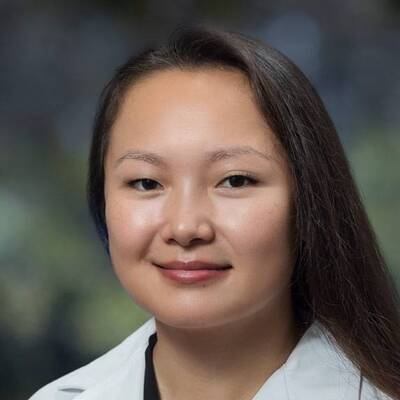
“Usually when someone has been shot in the head, it’s an unsurvivable injury,” says Ning Lu, MD, associate director of trauma and acute care surgery at Scripps Memorial Hospital La Jolla. Dr. Lu, a general surgeon at Scripps Clinic, was the attending trauma surgeon the night Tony was brought in.
“Normally, when a bullet goes inside someone’s head, there is so much damage that they’re not awake, they’re not talking, they’re not moving and they don’t need to be intubated,” she says. “That was not the case with Tony. He was awake, he was talking, he was moving. That in itself was shocking.”
Tony had sustained a skull fracture. Bullet fragments and the bullet itself were lodged in his brain — but they just missed a major artery.

Tony and Laura Elliott (center) are reunited with members of the emergency and trauma team at Scripps Memorial Hospital La Jolla to share their thanks for Tony's lifesaving care.
Neurosurgeon performs critical brain surgery
A neurosurgeon was able to perform tests to determine the extent of the injury to his brain function.
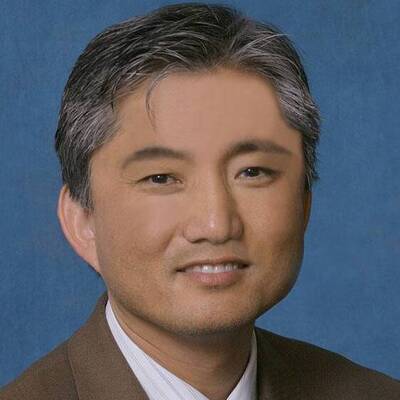
Frank Kevin Yoo, MD, Scripps neurosurgeon, performed craniotomy surgery and repaired the skull wound to the head the following morning.
“Fortunately, in our society, we're not a war zone, so gunshot wounds are rare. It’s unusual to get that call,” he says.
Dr. Yoo cleaned away bone fragments and repaired Tony’s skull. He continued to monitor Tony following surgery to make sure there wasn’t any swelling or bleeding.
“One of the things we are taught as neurosurgeons is that when a bullet traverses from one side of the head and comes out the other side, it causes damage along that track,” he says. “A gunshot wound that’s through and through is often not survivable.”
“When I saw the CT scan and heard people telling us that there was no exit wound, those were all good signs,” he continues. “Both radiographically on the CT scan and from looking at him, I knew he was going to survive this. I just had to get him through it, clean him up and make sure he didn’t have any serious complications, including managing intracranial pressure. As the brain swells in response to the injury, pressure within the skull can increase, potentially leading to further damage.”
From ICU to recovery
From ICU to recovery
After surgery, Tony was taken to the intensive care unit for close monitoring and management to avoid any other complications, including secondary injuries or infections. He was later moved to the trauma medical-surgical unit, where he began physical therapy.
Tony’s motor skills were off and his left side was numb, partially and temporarily paralyzed. He was unable to move his left arm or leg and experienced seizure-like tremors. He couldn’t focus his vision on anything left of center, it was difficult for him to speak and, understandably, he was in a lot of pain.
Laura remained by his side, keeping his spirits up as he slowly grew stronger. He worked with Scripps physical therapists and began the painstaking process of relearning how to stand, walk and use his left side. He continued to show improvement.
“I remember trying to move his leg for him,” Laura recalls. “I would sit on his left side purposely to try to get him to move his eyes toward me, and it was very straining.”
“I remember trying to encourage him to take his first steps,” she says. “It looked like he was pushing a boulder up a hill. He was using all his might just to move his foot an inch.”
Then came the thumbs up from Tony — the reassurance he needed to know he was going to be OK.
“He slowly lifted his left thumb up and that was the biggest relief, because that was the moment when I realized that this isn’t permanent,” she says. “There was hope. Something was coming back. It was just a matter of working on it.”
Tony was discharged on December 23 to a specialized traumatic brain injury center in Colorado. Dozens of staff members and police officers applauded and offered well wishes. Scripps President and CEO Chris Van Gorder, a former law enforcement officer also injured in the line of duty, was there to wish him well and offer Tony support throughout his treatment and recovery.
Seven weeks of rehab at Scripps
After graduating from inpatient care, Tony and his family returned to San Diego and Tony enrolled in Scripps’ Brain Injury Rehab Outpatient Program.
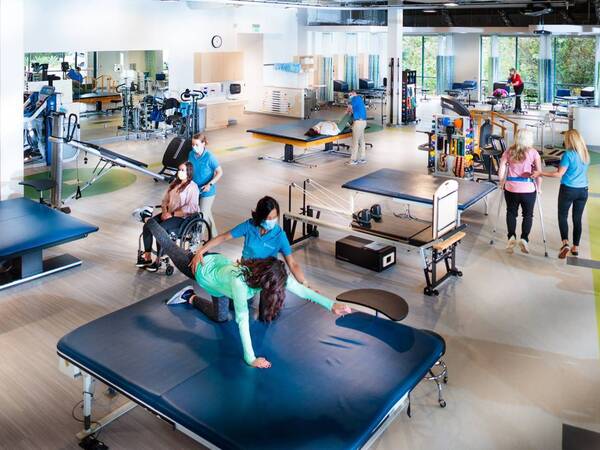
Scripps’ interdisciplinary brain injury rehabilitation center, part of Scripps Encinitas Rehabilitation Services, is uniquely qualified to care for people with traumatic brain injuries, as well as stroke and other neurological disorders. Patients work individually and in groups with a comprehensive team that includes physical therapists, occupational therapists, speech therapists, an audiologist and social services.
He also enrolled in the Scripps Day Treatment Brain Injury Program, or “brain camp.” Designed to re-establish neuropathways and help patients return to school or work after brain injury or illness, the program is intensive — more than six hours a day.
Tony finished in near-record time, just seven weeks.
Regaining strength, focus and mobility

Today, Tony Elliott is back on the job and is sharing his story in hopes of inspiring others. He still has a way to go, but is thankful for the Scripps teams that put him on the path to recovery.
Regaining strength, focus and mobility
From day one, his goal was to return to work, and Scripps staff was determined to help him get there. Activities like pickleball, modified hockey drills, boxing and holstering a gun-shaped wad of tape may sound unusual, but Scripps therapists tailor treatment to each individual, working on control, balance, reflexes, motor coordination, hand-eye coordination, multitasking and fast movement.
“Tony still had weakness on the left side of his body,” says Rebecca Aksew, a physical therapist at the brain rehab center at Scripps Encinitas. “In occupational therapy, we worked on coordination, strengthening and other things so that he could do stuff like drive or be able to use both of his arms to steady a weapon as a police officer.”
“He also had speech therapy and worked on his attention, memory and speed of processing — all so he could make really quick and safe decisions that were appropriate and not impulsive,” she adds.
There were also everyday things to work on, like navigating uneven surfaces, walking uphill, paying attention to traffic and stepping up and down curbs.
At one point, all of Tony’s training was put to the test. Laura’s car broke down with the kids in tow after dropping him off.
“I asked Rebecca, ‘Can we help her out?’” Tony recalls. “We got in the bus they use to transport patients, drove out there and helped her jump the car with a deputy. It’s all therapy, right? Troubleshooting and forward thinking are about frontal lobe usage, and that’s the damaged area of my brain. It affects planning and decision making.”
Back on duty: A hero’s return and baby’s arrival
Back on duty: A hero’s return and baby’s arrival
All of Tony’s hard work paid off. Just shy of one year after the shooting, he returned to the police department. He was first assigned to light duty, but later transitioned to working in the field — same division, same shift, same team.
“Surviving at all is very unique, very special, very uncommon,” remarks Dr. Lu. “But to survive with such good function to the point where you’re able to not just return to any old job, but return to a job that is so mentally and physically demanding, that’s incredible.”
Days after Tony’s return to the force, the Elliotts' faced a different kind of challenge: the birth of their third child. “We call her our little miracle baby,” he says.
“Surviving at all is very unique, very special, very uncommon. But to survive with such good function to the point where you’re able to not just return to any old job, but return to a job that is so mentally and physically demanding, that’s incredible.”
Grateful for lifesaving care
Tony has been documenting his challenging recovery journey on social media, and this past year, spoke at the annual trauma reunion at Scripps Memorial Hospital La Jolla, reflecting on his recovery and inspiring others with his resilience.
He still has lingering numbness on his left side, but he’s continuing to build on what he learned in rehab. He’s beyond grateful for the care he received to get him there.
“From the moment I got to Scripps — the care I received before and after surgery, the administrative support and coming back to Scripps outpatient rehab — the caliber of health care was great,” he says. “Things could have turned out drastically different. There are a lot of people in the health care system who made a difference. I’d like to connect with all of them to say thank you.”
This content appeared in San Diego Health, a publication in partnership between Scripps and San Diego Magazine that celebrates the healthy spirit of San Diego.
Related Providers
Ning Lu, MD
Frank Yoo, MD
Related Services
Trauma Care
Trauma Care
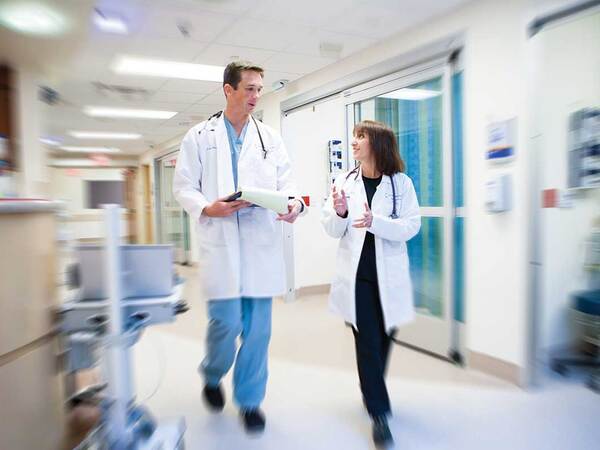
Scripps Health has 24/7 trauma centers at Scripps Mercy San Diego (level 1) and Scripps Memorial Hospital La Jolla (level 1) serving all of San Diego County.
Emergency Care
Emergency Care
Find the address and services of Scripps emergency rooms, including our locations in Encinitas, La Jolla, Hillcrest and Chula Vista.
Related Locations
Scripps Memorial Hospital La Jolla
Scripps Memorial Hospital La Jolla
9888 Genesee Ave.
La Jolla, CA 92037
Scripps Encinitas Rehabilitation Services
Scripps Encinitas Rehabilitation Services
1092 N. El Camino Real
Encinitas, CA 92024